

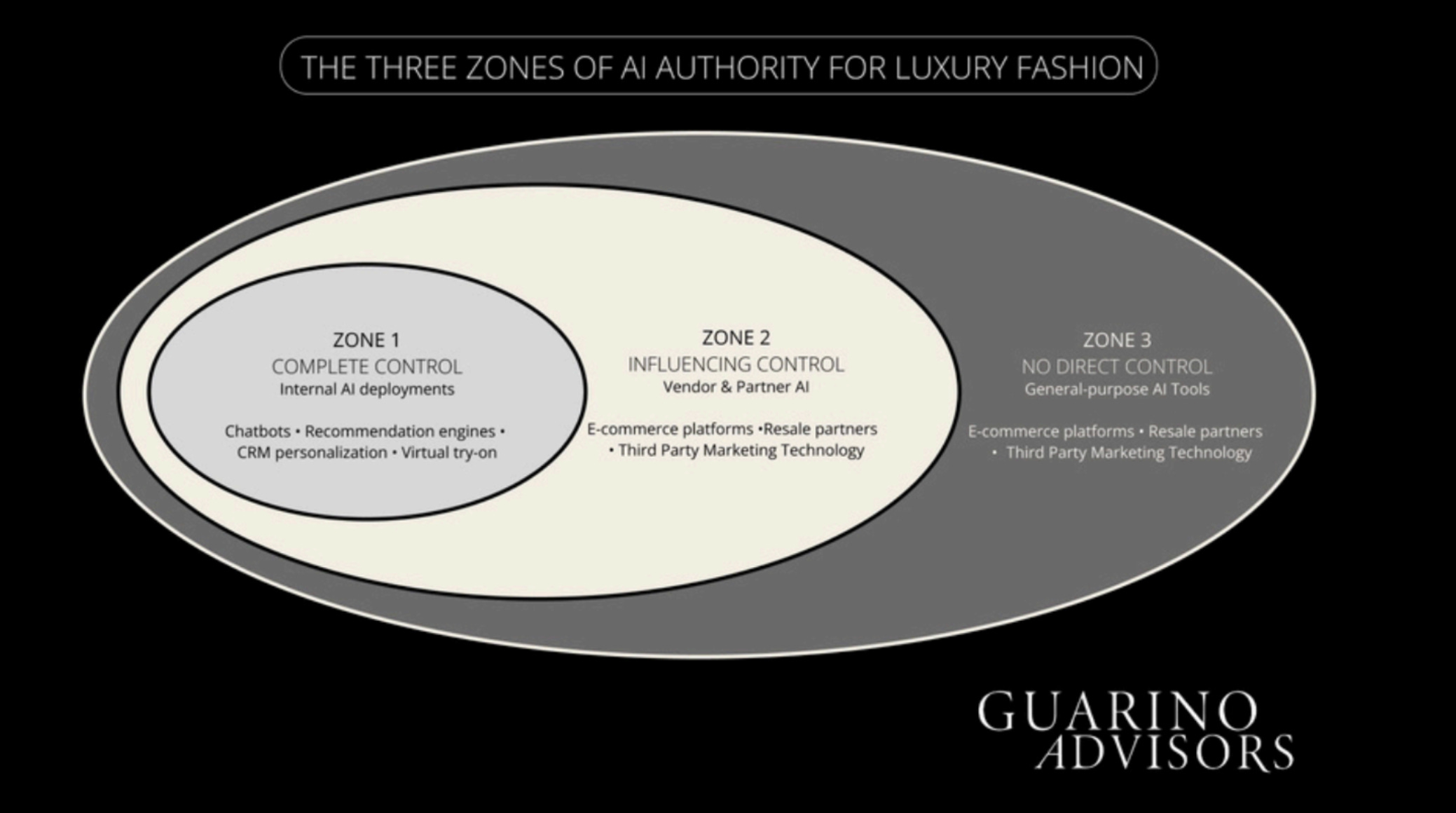
Luxury fashion operates in three zones of AI control: complete control, influencing control and no direct control. In a world where AI stands between brand and consumer at nearly every touchpoint, it's important for brands to understand where they have authority over AI’s impact in the supply chain and where they do not.
Zone 1: Complete Control
Internal AI Deployments
In July we covered Zone 1, the AI tools a brand deploys and controls. From virtual try-on features, to CRM personalization or generative campaigns, these are the consumer-facing integrations that brands directly govern. “Complete Control” is the first of the three zone framework outlined in Govern What You Build, a recent Guarino Advisors paper detailing AI authority in fashion business.
With increased industry concerns, including recent updates on the Phia story - confirming that Phoebe Gates knew that her company, Phia, was taking commission off of affiliate sales it did not generate, we now cover Zone 2: “Influencing Control”.
Zone 2: Influencing Control
Vendors & Partner AI
Zone 2 is the space in the supply chain where brands must make a conscious effort to have oversight. It is the AI tools and integrations that their vendors run, including e-commerce, transaction processors or resale partners. Oftentimes, the technology is developed independently from the brand and hired externally as a plug in or subscription to fulfill operational needs. Despite separation in business, the consumer on the other end of the funnel experiences a singular journey with the brand name attached at every output, risking brand financial loss and reputation if any AI function fails.
For that reason, the second section of the three-zone framework outlined in my latest paper Govern What You Build answers the critical question every entity in fashion should be asking: If a brand didn’t build the AI its partners run, who is responsible for answering to its failures?
Liability Protection When Dealing with Vendors
This is a structural blind spot the industry has yet to name. In fact, AI operating inside the vendor layer has received almost no governance attention across any sector. Only 6% of organizations report complete oversight of how vendors are using AI within their services, and only 8% consider their internal AI governance model mature.
In fashion however, Vogue Business and IBM alerted that vendor dependency is particularly high. They documented multi-layered partnership dynamics in which each integration point carries its own AI exposure. For that reason, “selecting the right partner is one of the most important decisions for businesses looking to leverage AI, ensuring solutions are designed to integrate seamlessly with complex, regulated and large-scale business environments where system failures would pose critical”.
Aon’s 2026 risk analysis confirms the trajectory: AI is amplifying dependencies on third-party technical systems and according to the 2025 Stanford AI Index Report, harmful AI-related incidents are increasing year-on-year. That is the structural exposure.
Industry-Adjacent Example
To visualize impact in an adjacent industry: A high-end jewelry establishment contracts a firm to install the store locks. The firm then implements AI automatic locking mechanisms and installs them in the jewelry establishment. If one smart lock fails the accountability falls onto the vendor as the contractually bound security partner. Maintaining secure locks was their responsibility and in this scenario, they breached it. Just as jewelry, finance, defense and other high trust sectors have developed oversight measures for external protection, in the age of AI, fashion must do the same with their vendors. The risk of not doing so is financial loss, reputational harm and as regulation comes into play, there are also fines and penalties.
AI Regulation
The regulatory consequence is already codified. The EU AI Act, Article 26, places legal accountability on both providers and deployers of AI. Thus, luxury fashion brands integrating third-party AI without contractual governance requirements are not insulated from that liability. It states: “The law does not distinguish between AI a brand built and AI a brand adopted. It distinguishes between AI that was governed and AI that was not.” Confirming that when AI fails in the fashion supply chain, both the brand and its vendors can be held accountable.
To learn more about staying protected and how to implement oversight on external partners as a fashion brand or business, read the full paper Govern What You Build: The Only Path to Consumer Trust in Fashion’s AI Decade.
Coming next, Zone 3: No “Direct Control”. Covering the general-purpose AI tools consumers use to discover, judge and buy luxury, and where a brand’s authority ends entirely.