


Luxury fashion operates in three zones of AI: the AI it builds, the AI used by its vendors and the general-purpose AI that regurgitates its historical digital presence. Only one of those zones sits under a brand’s complete internal control, categorized as Zone 1.
This post debriefs just one section of the three-zone framework from my latest whitepaper Govern What You Build and answers the following practical question: if a house owns the AI outright, what governance risks should it mitigate?
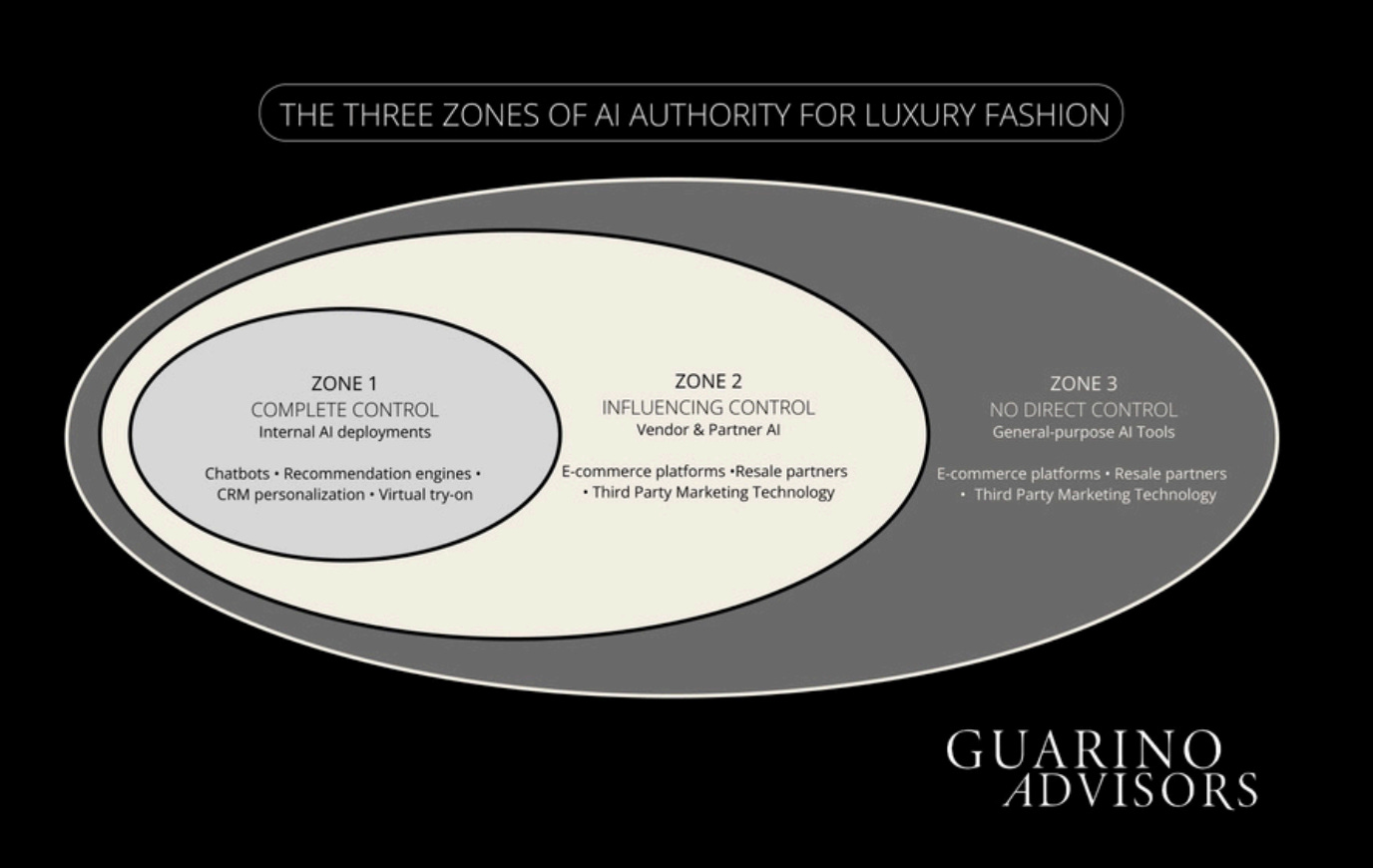
Zone 1 is the zone fashion brands already occupy. It encompasses every AI tool a brand directly deploys: website recommendation engines, on-site chatbots, virtual try-on features, CRM personalization, generative campaign tools, merchandising and demand forecasting, dynamic pricing and in-store clienteling. They are live integrations and consumer-facing systems making consequential decisions at scale. Yet they are being built and deployed without the governance discipline that mature industries would consider non-negotiable for comparable decision tools. The industry’s own coverage, which notably lacks depth in governance discussions, demonstrates a lack of risk-mitigating initiatives when it comes to internal AI deployment.
The Current Posture Is Just Not Enough
The evidence lies in public communications industry-wide. A 2026 Vogue Business feature on the future of retail AI profiles Bain’s customer digital twin model and Random Studio’s invisible-AI design philosophy as the operational direction of luxury, documenting significant AI integration across the sector without a single reference to governance structure. The omission reflects the industry’s default posture: deploy first, govern when something goes array.
Concerning Inadequacies
Sure, a brand can deploy AI into their website in just a few clicks, but governing it is a completely different process, and at that, it’s an ongoing one. For those who govern their internal AI, answering a short list of ownership and accountability questions is straightforward. For those who don’t, the structural obstacles inhibiting them from doing so likely fall into two overarching categories.
Unclear ownership. The first is lack of model ownership, an evident gap across industries. A Forbes study showed nearly 80% of organizations report unclear ownership of AI initiatives altogether. Without a named senior individual accountable, performance baselines measuring AI degradation, or board visibility on deployment decisions, the investment is a live risk. Structurally, it’s like sending a spaceship to the moon with an anonymous pilot and, only after it crashes, wondering who is going to take the blame for poor navigation. Pilots own their mission and hold responsibility for it, avoiding a crash at all costs. Follow the logic. Internal AI deployers without this structure are flying anonymous.
Negligent Contracts. The second is poor vendor contract AI governance. Almost all AI vendor contracts claim data usage rights beyond what is necessary for service delivery. This leaves consumer data vulnerable and frequently enables data usage for model retraining without explicit consumer consent. For industries whose entire value proposition rests on discretion and consumer trust, the absence of documented governance requirements cannot be a peripheral concern for luxury fashion.
Procrastinating internal AI governance will lead to failure.The two obstacles mentioned can turn into company-wide downfalls in the blink of an eye, producing downstream operational, brand and legal failures.
The Obligation of Complete Control
My proposed framework to close the governance gap consists of four pillars and three of them apply to Zone 1 directly, as its activity has the greatest impact on luxury houses. When Zone 1 is secure, regulated and efficient, it permits these brands to reap the long-term benefits of whatever AI investment they decide to make. You can trust the machine, but trust has a precondition. Someone accountable did the work before the machine was deployed.
Coming next, Zone 2: Influencing Control. Covering AI deployment by the direct partners and vendors luxury brands operate alongside and how authority thins. Subscribe to get it delivered straight to your inbox.

The three-zone framing is useful because it makes governance proportional to control. The more of the system an organization can actually determine, the harder it is to treat ownership, baselines, escalation and accountability as someone else’s problem. Zone 1 is especially important because complete operational control should also mean the clearest responsibility boundary before deployment, not after something fails.