

AI has taken over the world. It’s inserted into every conversation, every news article, campaign and experience. It’s come to be a central part of daily life. So how is it that the one topic that we can’t seem to escape is still so unregulated and ungoverned?
The truth of the matter is, technological advancements get ahead of our own planning. They inspire a wave of movement and ideas that feel too exciting to stop and that don’t warn us to prepare. For that reason, we urge society to halt, just for a moment. To center ourselves, unify and think critically about what AI really entails.
As an expert in governance, having led developmental regulation in various industries, from finance to defense, I take ownership of urging this awareness. I developed my firm, Guarino Advisors, to partner with leaders, founders, executives and boards to navigate growth during these convoluted times. We guide and advise businesses, specifically luxury fashion businesses, on governance, technology risk, capital strategy and scalable operating models to stay compliant and protected. Our perspective is grounded in first-hand operating experience across audit, finance and risk oversight, all informed by my background as a CPA and former Defense company CEO. The EU AI Act and ensuring our clients know everything they need to know about upcoming regulation, is part of that work. If you are a fashion business or leader, we invite you to participate in the exercise. Read along for details of the EU AI Act: what it is, what it means and how to use it to protect yourself, your consumers and the sustainability of your business.
The EU AI Act
What Is It?
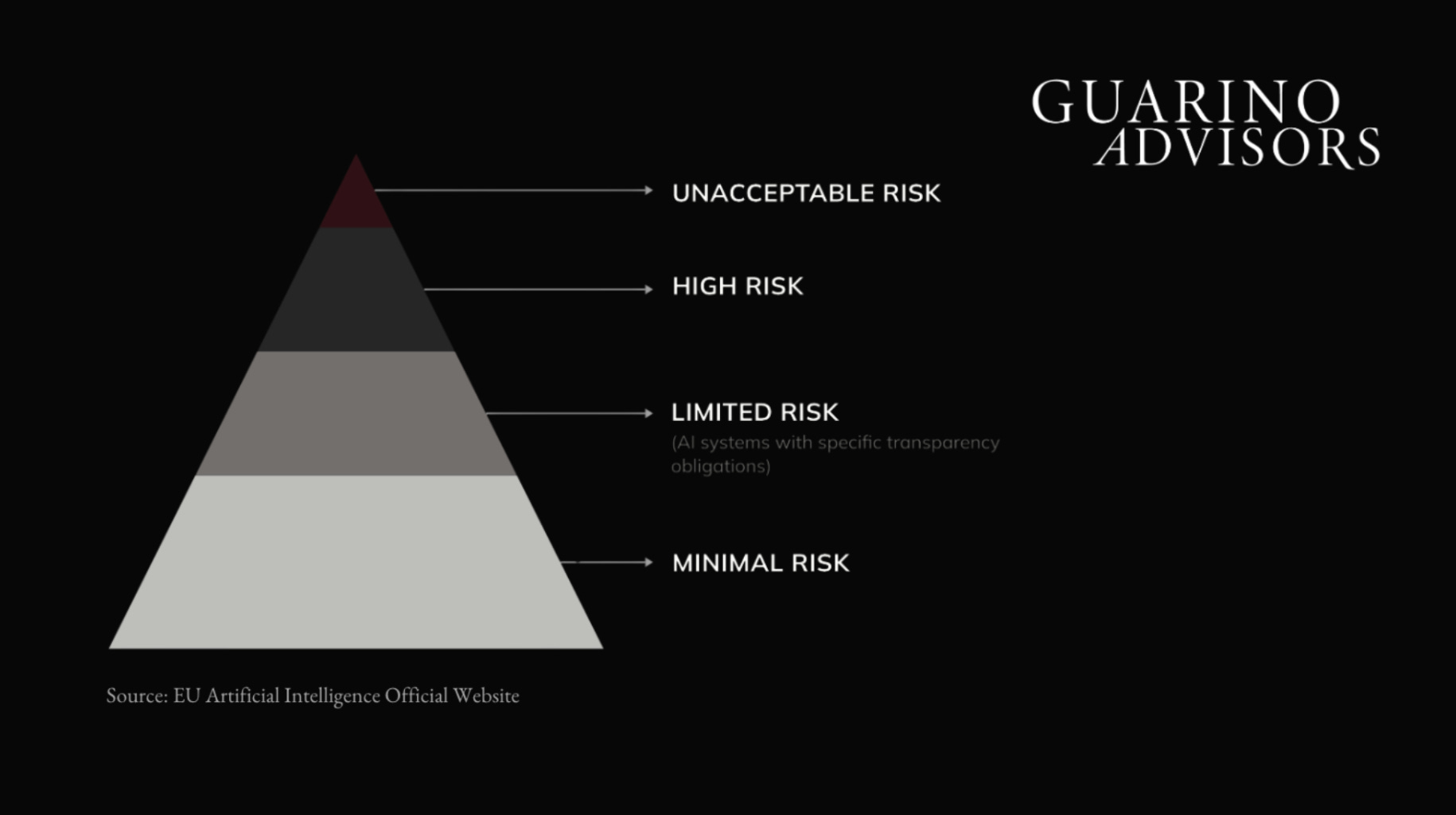
The EU AI Act is the EU’s first comprehensive legal framework for AI, setting harmonised rules across all member states. Its purpose is to accept that AI is here to stay, while addressing the risks that come with it. The legal framework includes guidelines on what entities are allowed and not allowed to use AI for and sorts AI systems into four risk tiers with different obligations. It is a first step in regulation and one that will affect businesses far and wide. First in the EU and then in the rest of the planet.
The four tiers are: unacceptable risk (banned for businesses), high risk (heavily regulated), limited risk (transparency on AI use required) and minimal risk (unregulated, covers most current AI applications).
All information sourced directly from the EU AI Act’s Official Website
When Does it Start?
The Key Dates to Stay On Top Of
Because this is wide scope regulation, it is not all implemented at once. It is an incremental process that will affect businesses slowly but surely. Here is what to expect in terms of timeline.
At six months, prohibitions apply, meaning you can’t use AI to read employees’ emotions (except for medical/safety reasons), infer sensitive attributes like race or sexual orientation from biometric data, scrape images to build facial recognition databases or use manipulative AI that harms customers. At twelve months, obligations for general-purpose AI models kick in, mostly affecting the vendors behind the AI tools you use rather than your own operations directly.
At twenty-four months, high-risk obligations apply. High-risk includes covering AI used in recruitment, candidate screening, targeted job ads, performance monitoring, promotion/termination decisions and evaluating creditworthiness (relevant if you offer financing), requiring you to maintain a risk management system, clean data, technical documentation, record-keeping, human oversight and adequate accuracy and cybersecurity. At thirty-six months, high-risk obligations apply, covering AI embedded as a safety component in products regulated under other EU laws.
Separately, transparency rules for chatbots and AI-generated content (like deepfakes) will be required, so it’s worth building disclosure habits early. Stay tuned as we will roll out more content on this.
How to Prepare?
Implications of the EU AI Act
To protect yourself, ensure you are building awareness across your organization and prioritizing governance foundations and budget allocation from the outset. Consult with advisors who can guide you through intricacies, so their importance isn’t overlooked as the deadlines approach.
To protect your consumers, be transparent about where and how AI touches their experience, from chatbots to AI-generated content. Evaluate AI for fairness and manipulation risk before it reaches the public and consult with advisors or legal counsel who can help spot where the regulation would flag as harmful.
As for the sustainable growth of your business, make sure governance isn’t a one-time compliance exercise but a standing part of how you evaluate and adopt new AI tools going forward. Prioritize building internal processes so future AI adoption slots fit into an existing workflow. Once again, consult with advisors regularly so your practices keep pace as the regulation and your use of AI both evolve.

such a thorough and informative reporting and analysis of what AI policies are actually taking shape in a very noisy news space - really appreciate it!